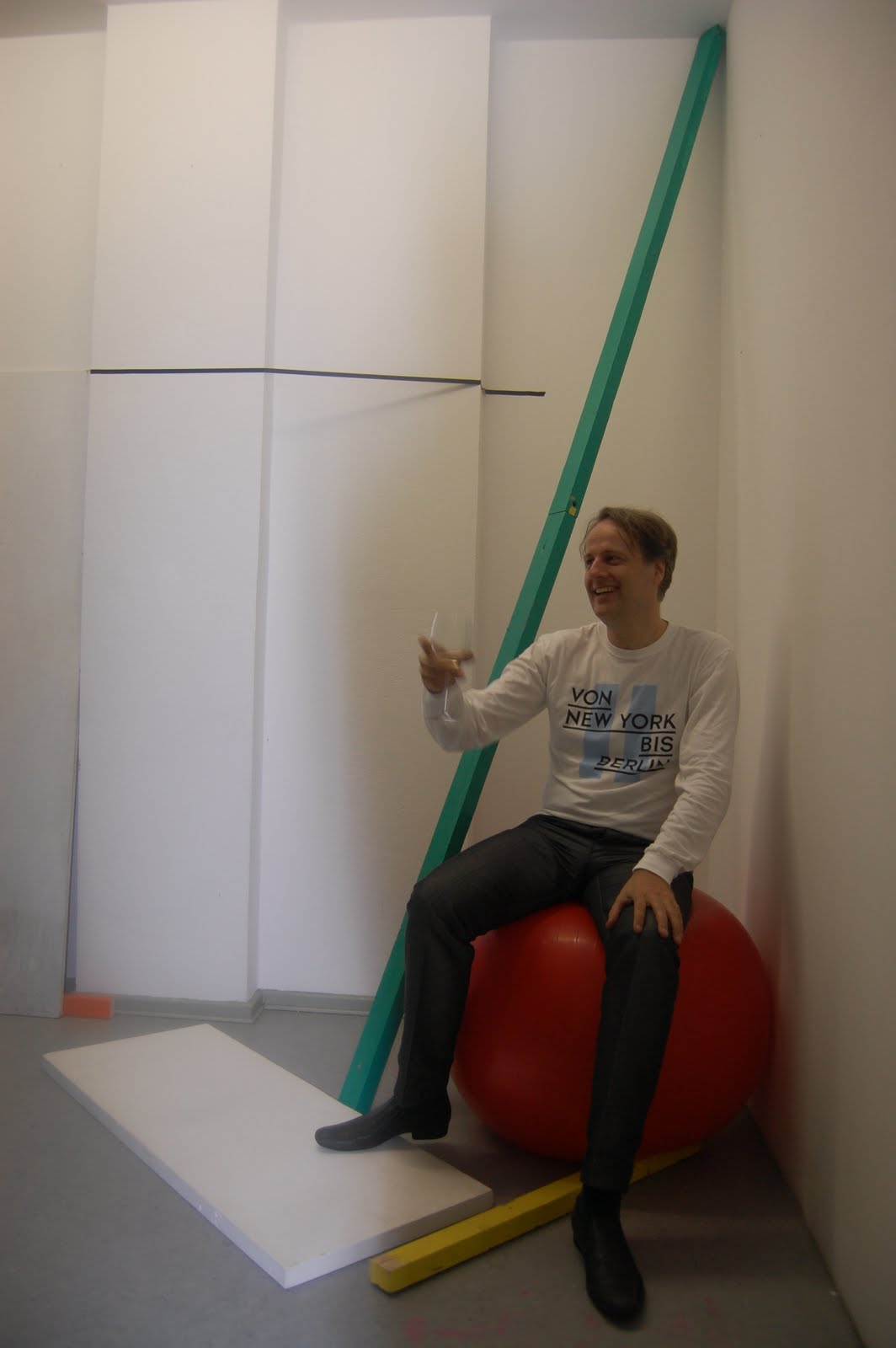
Kunstruimte 411 presenteert "Residu".
Kunstenaars: Barbara van Ittersum, San Proper en Tanja den Broeder
English below
Image: Barbara van Ittersum
.jpeg)
Kunstruimte 411 presenteert "Residu".
Kunstenaars: Barbara van Ittersum, San Proper en Tanja den Broeder
English below
.jpeg)
In order to rethink the viability of "trash-art", Walter Benjamin's arguments on 'garbage/trash'(Abfall) and 'rag-picker'(Lumpensammler) are most stimulating. In the past I have called Benjamin's method a "technique of garbage collection"[1]. I dubbed it this considering Benjamin's idiosyncratic materialism that interprets beings as garbage/trash, his historical philosophy which views creation less as output than as rearrangement, and the movements in the methodology of semiotics and deconstruction that developed following Benjamin. In a letter to his friend Gershom Scholem (August 9, 1935), in which Benjamin explains the concept of his later "Passagenarbeiten" treatises, he comments that "this work uses surrealism philosophically and sublimates (aufheben) it, at the same time attempts to capture an image of history in those things that present existence (Dasein) most subtly fixed, in other words in the "garbage/trash" of present existence.[2]
Radical Surrealist montage technique was well-known to Benjamin, but his aim was to develop it into something more profound--a means of historical awareness. In his "Theses on the Philosophy of History," a condensed version of his view of history using montage techniques (or what William Burroughs would describe as "cutup") are the following words: "The true picture of the past flits by. The past can be seized only as an image which flashes up at the instant when it can be recognized and is never seen again."[3] That "image never seen again" is not an image from some great event, but an image that appears in the "waste" of no consequence, and those able to bear witness to it are not "heroes" or some class with special privileges, but the "oppressed."
In a review written by Benjamin in 1930 that passed virtually unnoticed, there is a brilliant passage which describes vividly what constituted his "technique of garbage collection." This is a review of "The Employee" (Die Angestellten), one of the early works of Siegfried Kracauer:
A rag-picker who picks up garbage early in the gray morning. Muttering darkly to himself, getting a bit drunk, he spears the remains of speeches and fragments of words with his stick, and throws them into his cart. Occasionally he picks up scraps of these hackneyed phrases like "human beings," "innerness," and "deepen," and flutters them contemptuously in the morning breeze. He is the morning garbage collector, but this morning is the morning of the day of the revolution.[4]
Kracauer, later in exile in New York and battling with extreme hardship and illness, analyzed the details of German film chiefly of the 1920s and 30s--the enormous "garbage of history"--and wrote "From Caligari to Hitler"(1947), which exposed incisively the collective unconsciousness that paved the way for Hitler's rise to prominence and was then flattened by the force of it.
To Benjamin, "garbage/trash" was the trivial part, the detail of enormous things, in other words, the minute. His mode of thinking was called "micrology". His attention to them was a stratagem in response to the movements of an era in which the will for power was still directed toward spatially enormous objects. The latter half of the twentieth century, however, is an era of "posts": "postindustrial," "postmodern," "postcolonial," "postnuclear," "postmassmediatique" . . . each in turn revolves on the axis of time and is sent on its way. Here, trivial things and minute things cease to be alternatives to the will for power, because not only does power itself no longer seek large things, it accepts the trivial and the minute. Therefore, "small is beautiful."
Theodor W. Adorno, while in one aspect having already adopted Benjamin's idea of "only through the details can we hope for a passage to the whole"[5] as his own mode of thought, also indicated to Benjamin his doubts about this method. To Benjamin, "garbage collection" not only gave form to a method of thought, it actually played an "important role" in the debate on the "passages" (arcades) of 19th century Paris. In a 1938 letter to Benjamin from exile in New York, Adorno made the following comment:
The problem is the rag-picker. To my mind the definition of the rag-picker as a marginal character personifying the very lowest level of poverty does not fulfil at all the promise of the term rag-picker when it appears in one of your texts. (abridged) I assume this shortcoming is related to the fact that the capitalist function of the rag-picker, i.e. the function that makes even beggars subordinate to their exchange value, is not made clear. Could I be reading too much into it all[6]?
Adorno, who was eventually to outlive Benjamin, was finally to write: "All post-Auschwitz culture, including its urgent critique, is garbage(Muell),"[7] and this demonstrates the pessimistic perceptions of Adorno in his belief that all "trivia," "details" and "minute things" are ashes and dust, and all that exists is endless ruin. The world would become not a "slum" littered with "garbage/trash" but would resemble a city after a nuclear attack, a ruin in which even the "details" cannot be discerned.
Benjamin's garbage collection technique directly supposes film montage. The reason his technique did not simply remain an application of the film technique known as montage is because he had a firm grasp of several techniques within the basic movements in thought and technology, i.e. the historical threads flowing into film montage--premodern storytelling, the 'rencontre fortuite' of surrealism, and even "quotations" of Berthold Brecht--and understood their meaning at the most basic of levels. However the digital technology that constructs virtually what does not really exist was not within the technological scope of Benjamin. Though things may be broken up, transformed into garbage and lose their wholeness, they do actually exist as extensions of the body. The electronic world of digital technology however, belongs to a level estranged from any extension of the body. This is, so to speak, the virtual "paradise" built on the "waste" and "ruins" of Adorno, and is "Utopia," literally no-place. Adorno's "pessimism" thus reverses itself into a positivism of electronic space.
Cyberspace is a no-place that nothing physical can exist. This is an ultimate form of garbage/trash where no body can survive. Art is an art that something physical flashes up at the instant over the space. Art can continue to exist only in the phase of time. Due to the cyberspace that exterminates physical element, live human body could reactivate itself in the temporal relation with it. Trash-art in the cyberspace will go to live action such as the live streaming.
Notes:
[1] Tetsuo Kogawa, Shutai no Tenkan (Changing the Subject). Tokyo: Miraisha, 1978, pp. 235-8.
[2] Gershom Scholem and Theodor W. Adorno, eds., Walter Benjamin, Briefe 2. Frankfurt am Mine:Suhrkamp Verlag, 1978, p.685.
[3] Hannah Arendt, ed., Walter Benjamin, Illuminations. Translated by Harry Zohm. New York: Schocken Books, 1968, p. 235.
[4] Hella Tiedemann-Bartels, ed., Walter Benjamin Gesammelte Schriften III. Frankfurt am Mine:Suhrkamp Verlag, 1971, p.225.
[5] Theodor W. Adorno, Ueber Walter Benjamin. Frankfurt am Mine: Suhrkamp Verlag, 1990, p.87.
[6] Ibid., pp.159-160.
[7] Theodor W. Adorno, Negative Dialectics. Translated by E.B. Ashton. New York: The Seabury Press, 1979, p.367.
(I appreciate Pamela Virgilio Miki for her help totranslate the original Japanese text into English.)
Isaev Alexsei(ed.): The look from the East, Media ArtLab, Moscow, 2000
Hierbij enkele foto´s van de opening van Tomorrow is Today, de tentoonstelling die zaterdag 4 april, 2026, opende in de Amstelkerk in Amsterdam. De tentoonstelling loopt tot en met 24 april.
English
Here some photos of the opening of Tomorrow is Today in Amsterdam, April 4th, 2026. The show is visitable until April 24th in De Amstelkerk, Amstelveld 10, Amsterdam.
Nina Boas, performance photos
Nina Boas: "I create sensory, temporary spaces that invite slowing down, connection, and imagination. My work balances between art and ritual, offering opportunities for collective healing, inner navigation, and reconnection with the body, the landscape, and our ancestors."
English
Performance artist Hans Kuiper cooperated with VR specialist Sander Veenhof and designer Arjan van Amsterdam with the use of the Quest3 glasses, for a sound performance, using several parameters in a virtual 3D grid, connected to sound only. The performance shown here on video was a try out, for the actual, performance in the Amstelkerk in Amsterdam (april 2024), during the Salon Kuiperdomingos Projects, organized by Kunstruimte 411 (Art Space ´411´), you can find at the 411 Instagram account.
Nederlands
Kunstenaar Sander Veenhof, Arjan van Amsterdam en ik zijn in 2024 bezig geweest met de voorbereiding van een performance in Amsterdam, bij de Lentesalon georganiseerd door Kunstruimte 411. Hier een eerste verkenning op video, het was voor mij toen ook de eerste keer dat ik met deze visuele sound app (zo noem ik het maar even) werkte, dus ook voor mij was het een experiment.
Op de instagram -account van Kunstruimte 411 staat een korte registratie van de uiteindelijke performance in de Amstelkerk in 2024.
(Geluid aan!)
— Sander Veenhof (@sander) February 22, 2024
Kunstenaar/performer @hanskuiper verkent de eerste versie van een "AR" app (zonder AR) die ik aan het maken ben voor z'n aankomende optreden in de Amstelkerk in A'dam
De #Quest3 bril volgt de bewegingen van zijn handen waarmee hij de pitch van geluiden bestuurt pic.twitter.com/YFjQix3YLP
Pass by at the Salon of the biggest art club in Amsterdam, Arti et Amicitiae, 200 plus artists show latest work. There will be a performance program with a performative installation of artist Hans Kuiper.
You are welcome!
For more information check www.arti.nl & www.hanskuiper.com
ENGLISH BELOW
Kunstruimte 411 organiseert deze zomer weer een zomersalon met de titel:`BOOM BOOM CHA´.
Art Space 411 presents BOOM BOOM CHA, a new Summer Salon with participants from Amsterdam, Berlin, Leipzig, Hamburg, Brussels and Haarlem.
(Image: Linda Weiss)
Kunstenaars die bevestigd hebben deel te nemen: Wafae Ahalouch, Arjan van Amsterdam, Anna Bolten, René Bosch, Margreet Bouman, Ronja Brainstorm (Leipzig), Anna Firmberger (Berlin), Maud Fernhout, Archi Galentz (Berlin), Margriet Gehrels, Willem Gorter, Alissa Guillouet (Brussel), Sina Khani (Berlin), Claudia Mulder, Eva van Ooijen, Hans Kuiper, Lucas Lelieveld, Urs Moore, Paul Ouwerkerk, Jean-Philippe Paumier, Luciano Pinna, Antonio Rego (Hamburg), Jean-Philippe Rousset, Ronald Ruseler, Tarik Sadouma, Ben Sampson, Markus Schaller (Berlin), Ivo Schouten, Ruth Spetter, Rutger van der Tas, Marjolein van Veen, Maria van der Velde, Gerard Veldman, Steffen Vogelezang, Ilja Warmerdam, Linda Weiss (Berlin), Jeroen Witvliet, Andreas Wolf (Berlin), Marius van Zandwijk e.a.
Media: schilderijen, fotografie, video, performance, tekeningen .


Design: Mikel Orfanos
Kunstruimte 411/ Art Space 411 will co-organize two exhibitions in Berlin in the autumn/ winter of 2024-2025.
The first, Herbstspaziergang, in cooperation with InteriorDaSein and Toolbox will open October 25th, 2024.
The second, Reclaim Reality, in cooperation with Rosalux will open November 29th, 2024. On this show later more.
A selection of artists based in the Netherlands will show latest work together with a selection of Berlin based artists.
Participants in Herbstspaziergang:
Jessica Assmann-Zwaanswijk, Rene Bosch, Aquil Copier, Daan van Houten, Sina Khani, Hans Kuiper, Antonio Rego, Tarik Sadouma, Gerard Veldman, MC de Waal, Ilja Warmerdam, Marius van Zandwijk, Piet Zwaanswijk.
Participants in ´Reclaim Reality´ (Opening Nov. 29th)
Deutsch
411 wird in Oktober und November 2024 zwei Ausstellungen organisieren in Berlin! Das zusammen mit drei Berliner Projektraeume, InteriorDaSein, Toolbox und Rosalux. Die erste Ausstellung, Herbspaziergang, eroeffnet den 25. Oktober in InteriorDaSein und Toolbox, den zweiten, ´Reclaim Reality´ den 29. November in Rosalux, ueber diese letzte Ausstellung wird spaeter mehr Information publiziert werden.
Es wird ein Selektion von Kuenstler/innen mitmachen die in der letzte Jahren ausgestellt haben in 411 zusammen mit Berliner Kuenstler/innen.
Teilnehmende in ´Herbstspaziergang´:
Jessica Assmann-Zwaanswijk, Rene Bosch, Aquil Copier, Daan van Houten, Sina Khani, Hans Kuiper, Antonio Rego, Tarik Sadouma, Gerard Veldman, MC de Waal, Ilja Warmerdam, Marius van Zandwijk, Piet Zwaanswijk.
Teilnehmende in ´Reclaim Reality´:
Wafae Ahalouch, Arjan van Amsterdam, Jessica Assmann-Zwaanswijk, Aquil Copier, Iliya Fogg, Margriet Gehrels, Alissa Guillouet, Daan van Houten, Sina Khani, Hans Kuiper, Dirk van Lieshout, Claudia Mulder, Beth Namenwirth, Eva van Ooijen, Jean-Philippe Paumier, Guido Pera, Luciano Pinna, Antonio Rego, Maarten Rots, Jean-Philippe Rousset, Tarik Sadouma/ The Rise of the Unsafe House, Ivo Schouten, Jorrit Sinke, Rutger van der Tas, Marjolein van Veen, Sjimmie Veenhuis, Steffen Vogelezang, MC de Waal, Ilja Warmerdam, Marius van Zandwijk, Piet Zwaanswijk.
(Image: Antonio Rego)
(Image: Kuiperdomingos Projects, Berlin, 2011)
In April-May 2024, a Spring Salon salon will be organized by Art Space 411, this time in Amsterdam. Curators Hans Kuiper (Amsterdam) and Tiny Domingos (Berlin) invited 37 artists from Amsterdam, Berlin, Hamburg, London, Marseille and Haarlem.
The aim of the exhibition is to honour artists who, outside the museum and gallery circuit, create independent spaces and initiatives to present practices with the visual arts as a starting point. For the curators of this project, these spaces are sanctuaries of cultural participation and inclusion, beyond institutional, commercial and political interests, essential for new perspectives.
Opening April 5th, 5pm at the Amstelkerk, Amstelveld 10, in Amsterdam. The show runs till May 3rd 2024.
Artists: Arjan van Amsterdam, Wafae Ahalouch, Nina Boas, Eline Boerwinkel, Rene Bosch, Tiny Domingos, Bella Easton, Frank Diersch, Andre Evers, Archi Galentz, Rosie de Graaf, Alissa Guillouet, Kirsten Hutsch, Patrick Huber, Sina Khani, Hans Kuiper, Anton Laiko, Ute Lindner, Claudia Mulder, Eva van Ooijen, Paul Ouwerkerk, Martyn F. Overweel, Luciano Pinna, Antonio Rego, Maarten Rots, Ivo Schouten, Jorrit Sinke, Kata Unger, Marjolein van Veen, Sander Veenhof, Sjimmie Veenhuizen, Gerard Veldman, Steffen Vogelezang, Ilja Warmerdam, Andreas Wolf, Marius van Zandwijk.
Art space 411 presents "The Spring Salon Kuiperdomingos Projects".
(design digiflyer: Arjan van Amsterdam)
In April-May 2024, a Spring Salon salon will be organized by Art Space 411, this time in Amsterdam. Curators Hans Kuiper (Amsterdam) and Tiny Domingos (Berlin) invited 37 artists from Amsterdam, Berlin, Hamburg, London, Marseille and Haarlem.
The aim of the exhibition is to honour artists who, outside the museum and gallery circuit, create independent spaces and initiatives to present practices with the visual arts as a starting point. For the curators of this project, these spaces are sanctuaries of cultural participation and inclusion, beyond institutional, commercial and political interests, essential for new perspectives.
Opening April 5th, 5pm at the Amstelkerk, Amstelveld 10, in Amsterdam. The show runs till May 3rd 2024.
Artists: Arjan van Amsterdam, Wafae Ahalouch, Nina Boas, Eline Boerwinkel, Rene Bosch, Tiny Domingos, Bella Easton, Frank Diersch, Andre Evers, Archi Galentz, Rosie de Graaf, Alissa Guillouet, Kirsten Hutsch, Patrick Huber, Sina Khani, Hans Kuiper, Anton Laiko, Ute Lindner, Claudia Mulder, Eva van Ooijen, Paul Ouwerkerk, Martyn F. Overweel, Luciano Pinna, Antonio Rego, Maarten Rots, Ivo Schouten, Jorrit Sinke, Kata Unger, Marjolein van Veen, Sander Veenhof, Sjimmie Veenhuizen, Gerard Veldman, Steffen Vogelezang, Ilja Warmerdam, Andreas Wolf, Marius van Zandwijk.
Art space 411 presents "The Spring Salon Kuiperdomingos Projects".
(design digiflyer: Arjan van Amsterdam)